
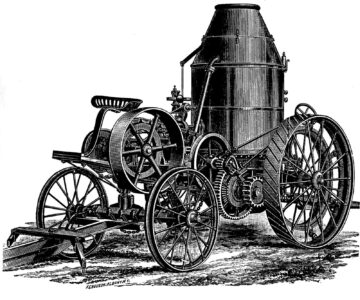
We’ve all heard of Westinghouse Corp; it’s a name that calls to mind electrical generators and power transmission. But not long ago I came across a copy of their 1886 catalog that revealed a piece of Westinghouse history largely forgotten to time: they made steam engines first. The title page reads in part: ‘We present herewith our Annual Catalogue, containing illustrations and descriptive articles of improved labor-saving machines, manufactured by us, and invite the careful attention of those who may be desirous of purchasing such machinery.
‘Our specialties are Grain and Clover Threshing Machines. Portable and Traction Engines ranging from Six to Fifteen Horse-power, horse-powers of various sizes and patterns, and Portable Saw Mills.
‘The present organization of our company is a continuation of the business commenced in 1836, and all connected with it have had unusual experience in the manufacture and operation of machinery of the kind we now offer. We have, therefore, the most thoroughly tested articles, and those of established reputation, and nothing whatever of an experimental nature to offer our customers.
“Our facilities for manufacturing are of the best, consisting of abundant buildings, machinery and material, so that we are prepared to supply a large demand, and we respectfully solicit continued favors from former customers and correspondence with all who are interested in machinery of the kind we manufacture.”

Westinghouse steam engines of the era had vertical boilers, the tapered top of which was designed to be ‘the nearest to a perfect spark arrester of all the many plans and devices that have been brought to our notice.’ The engine was said to have a short, quick stroke to make it lighter, while the cylinder, steam chest, cross-head guide, and the boxes for the crank shaft bearings were all cast in a single piece to assure mechanical exactness and perfect alignment of piston and crank. The design ‘brings the greater part of the weight below the center and removes all danger of turning over when on difficult roads.’ The engines were equipped with ‘every needed and desirable appliance for rendering the Engine efficient, durable and convenient, … including Adjustable Governor, Pop Safety Valve, Steam Gauge, Feed Water Heater, Direct Acting Pump, Whistle, Blower, Brake, and a full supply of wrenches and fire tools.’
The description of the 6, 10, and 15 horsepower traction engines is especially interesting and is quoted here:
“The engravings illustrate quite fully the plan employed for applying traction to our engine. It consists of large and strong Driving Wheels, Open Cog Main Gear Wheels, a Three Pinion Compensating or Differential Gear, and our improved Friction Belt Attachment. In the Friction Belt we claim to have made a decided improvement, and extended use has proven its efficiency. The following advantages result from it, viz.: The belt is a V shape, and runs upon pulleys with corresponding grooves. The pulleys are so arranged that they may be drawn apart by a tightener, and as much strain given to the belt as the work may require. The power communicated from the engine is therefore dependent upon the friction of the belt, and any unusual obstruction encountered while traveling will cause the belt to slip, and thereby prevent breaking up the gearing; and it also affords the means for starting gradually and of getting out of difficult places. These features will receive ready appreciation from anyone who has had experience with tight geared engines. When the belt is released by the tightener, the driven pulley may be brought in contact with a brake of the most powerful kind. Another important advantage gained by the use of the belt, is that of using two sizes of cone pulleys, by which means a change of speed can be quickly made. On smooth level roads a fast speed may be had, and on rough or hilly roads where more power and less speed is desired, the required change can be made. The two speed plan is adopted on the Ten and Fifteen Horse sizes. For the Six Horse size, only one size of pulley is used, furnishing speed in proportion to the lighter power. All of these engines are provided with a simple and reliable reversing apparatus, and are so arranged that the handling may be performed by one person upon the fireman’s platform. A steering apparatus may also be applied to any engine, although we do not recommend its use while running upon public highways. It is better and safer to depend upon a team (of horses) to guide (apparently Westinghouse didn’t have a lot of faith in the steering gear). The weights of the several sizes is so much less than the average run of engines that this of itself should commend them, when it is considered that weak bridges and soft ground are frequently encountered. Also the form of boiler we use makes it entirely safe in going up or down hill without carrying an excessive amount of water.”
Testimonial letters from satisfied users were an important part of farm machinery advertising in those days, and the catalog is full of letters from several states and territories, as well as one each from Australia and Argentina. Some of these letters are reprinted here:
From Medora, Ill.: ‘I have just finished threshing and the little engine has not been found wanting. I pulled my outfit up a hill, where the 12 horse utterly failed, and barely made it with 130 pounds of steam. My engine blew off at 110 pounds, and done the work comfortably.’
An Ohioan wrote: ‘I must say your engine is the best in this locality; we move it over mud and ice. I had no trouble so far; the roads are very icy, but we got over them like a top. In this same place there is an engine which got stuck most every day. I have hauled through mud, sand hills and ice, and haven’t thought of getting stuck yet. My engine is a 10 horse traction of the Westinghouse manufacture.’

From Seville, Mich.: ‘One place we went to they laughed at us for having so small a steamer (10 hp), but after awhile we blew off steam, and the men came off the mow and hallooed us to stop, saying they could not stand to get grain to her any longer without a rest.’
A custom thresherman from Atwood, Ill., wrote: ‘I ran the machine 52 days, including one wet week, and threshed 32,000 bushels of grain. As to fuel, I average 800 pounds of soft coal to 1,000 bushels of wheat, or in other words 75 cents to $1.25 per day (for fuel).’
The letter from Argentina read, in part:
‘In the first test here in the presence of several person accustomed to see threshing done by those big English machines, all agree that the ‘little Yankee thresher’ beats them all in every respect, which any blind man can easily perceive. I saw a large thresher and Ten Horse Strawburner Engine only thresh 300 bushels per day, and it employs 25 men. I feel confident that we can run all those large nuisances out of the country, as with their smooth bar cylinders they waste more than 15 percent of the grain.’
Most everyone has heard of Westinghouse Electric, but it seems those who didn’t know the company originally manufactured steam engines may have been missing out on one interesting piece of equipment and steam history. FC
Ever since his days as a boy on a farm in western Pennsylvania, Sam Moore has been interested in tractors, trucks, and machinery. Now a resident of Salem, Ohio, he collects antique tractors, implements, and related items.


